Palestinian citizens in Israel prepare for decisive 2026 election
Two million residents hold the key to the next government as they face record violence and persistent legal barriers.
By Haruka Ricci ·
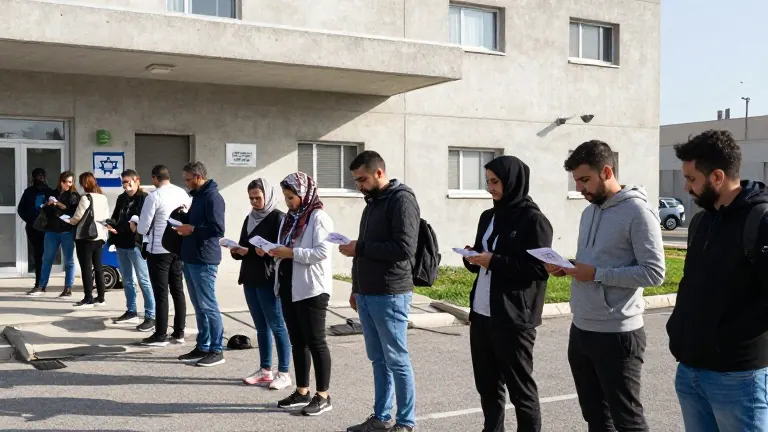
Approximately two million Palestinian citizens of Israel are preparing to vote in the upcoming general election. This group constitutes roughly one-fifth of the country's total population of 10 million. They are descendants of Palestinians who remained within Israel's borders after the 1948 war. Many live in the Galilee, the central Triangle region, and the Naqab desert. The community is diverse, with about 80 percent identifying as Muslim, 10 percent as Christian, and 10 percent as Druze.
The 2026 election marks a critical moment for these citizens. Political analysts project that Palestinian-led parties will secure between 18 and 20 Knesset seats. This potential bloc size could determine which coalition forms the next government. In 2021, the Ra'am party joined the ruling coalition, helping end Benjamin Netanyahu's 12-year tenure as prime minister. That move broke a long-standing political taboo against Jewish parties governing with Arab allies. Currently, Hadash, Balad, and Ta'al have reunited as the Joint List, while Ra'am runs independently.
Voters face severe security challenges. The year 2025 was the deadliest on record for Palestinian citizens, with 252 fatalities. This figure follows a sharp rise from 244 deaths in 2023 and 116 in 2022. Most victims were not involved in criminal activity. The Abraham Initiatives, an Israeli civil society organization, attributes the crisis to under-policing. Their 2024 report found that police solved fewer than 15 percent of homicides in Palestinian communities. In contrast, the clearance rate for Jewish victims was around 65 percent. Community representatives also accuse the police of neglecting the illegal arms trade.
Legal inequalities continue to shape daily life for the minority. Adalah, a Haifa-based legal center, has identified more than 65 Israeli laws that discriminate against Palestinians since 1948. These statutes affect land ownership, housing, and public funding. One early example was the Absentees' Property Law of 1950, which placed assets of those displaced in 1948 under state control. In 2018, the Knesset passed the Nation-State Law, which reserved the right to national self-determination exclusively for Jewish people. The law also downgraded Arabic from an official language to one with special status. Critics argue such measures reinforce a hierarchy between the two main demographic groups.
Historical context informs current political engagement. From 1948 to 1966, Palestinian citizens lived under a military regime that imposed curfews and movement restrictions. They endured events like the Kafr Qasim massacre in 1956, where soldiers killed 49 residents. The end of military rule in 1966 allowed for greater political organization. Protests in 1976 over land confiscation in the Galilee led to the annual commemoration of Land Day. Since then, parties like Hadash, formed in 1977, and the High Follow-Up Committee, established in 1982, have coordinated political efforts. The group seeks to leverage its voting power to secure equal civil rights and influence national policy.
The upcoming vote tests the strength of this political mobilization. For decades, Palestinian parties remained outside governing coalitions due to internal divisions and external resistance. The 2015 formation of the Joint List aimed to overcome the 3.25 percent electoral threshold. That alliance won 15 seats in 2020 but later fractured. Now, with the threshold still in place, the reunited factions aim to maximize their parliamentary presence. Their success will depend on maintaining unity while addressing deep community concerns about safety and representation.
Source: Middle East Eye