Student Unrest: France's 5.4% Deficit Clashes with 20% Budget Cut
Protesters demand infrastructure repairs while the government cites a debt load equal to 119% of GDP as the barrier to new spending.
By Lucas Chen ·
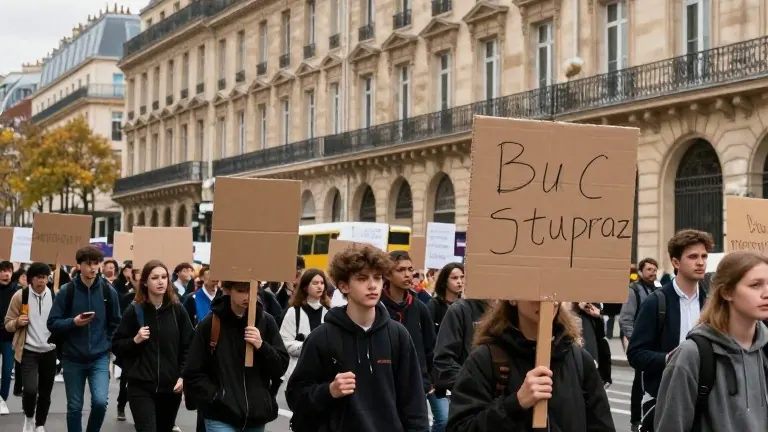
More than 410,000 people took to the streets in France on Saturday, with 110,000 gathering in Paris alone. The Ministry of Interior reported these numbers as student-led demonstrations continued for a second weekend. Participants cited overcrowded classrooms, aging infrastructure, and the rising cost of living as primary reasons for their presence on the streets. Many students blockaded campuses in mid-September to protest conditions that included 32 to 35 pupils per room and unreplaced teacher absences.
The protests have expanded beyond the student body to include teachers and civil servants. A report from the Organisation for Economic Co-operation and Development notes that French teachers earn a gross salary of 41,968 euros annually. This stands in contrast to their German counterparts, who earn 69,453 euros. Participants argue that social taxes and pension contributions further reduce their monthly take-home pay, while public funds continue to flow to private institutions.
The fiscal context for these demands is tight. The government is preparing a 54-billion-euro package of cost-cutting measures for the 2027 budget. This plan includes salary freezes for civil servants. Data from economist Lucas Chancel shows that the public budget for higher education and research has decreased by 20 percent since 2017. This drop is measured relative to the total number of students and adjusted for inflation. The shrinking resources have left many schools with buildings that lack basic maintenance.
Prime Minister Sebastien Lecornu acknowledged the tension in an address on October 7. He stated that the anger among young people did not appear suddenly and promised a government plan by the end of October. The government is also expected to announce changes to Parcoursup, the national online university admissions platform. President Emmanuel Macron met with student representatives for the first time on Friday. The session ended without a formal agreement, though Macron said in Marseille on Monday that he had asked the government to address the root causes of the movement.
The state faces a debt load of approximately 3.6 trillion euros, which equals 119 percent of the country's GDP. The annual budget deficit is forecast to reach 5.4 percent of GDP in 2026. This figure is well above the European Union average of just over 3 percent. A government report indicates that nearly one-third of certain ministry budgets go toward pensions for retired civil servants. This allocation reduces the funds available for education and other public priorities.
Economist Thomas Piketty argues that the issue is one of distribution rather than total wealth. He noted that private wealth in France has grown from 300 percent to 600 percent of GDP. This growth is concentrated among the wealthiest financial fortunes. He suggested that reinvesting in education and health would allow the economy to produce greater output with fewer resources. Antonio Fatas, a professor at INSEAD, added that France’s low growth limits the political options for solving the crisis through spending alone.
Source: Al Jazeera